A single oversight in your estate plan shouldn’t cost your child their lifelong healthcare; yet, it’s a common and serious concern for families nationwide. Mastering special needs trust rules is the only way to ensure an inheritance doesn’t accidentally trigger a total loss of essential government benefits like SSI or Medicaid. The stakes are that high. You’ve spent years advocating for your child’s needs. It’s only natural to feel a deep sense of anxiety when you think about what happens when you’re no longer there to manage the technicalities.
We understand that fear. It’s the weight of wanting to provide a comfortable life without jeopardizing the essential support systems they rely on. This guide is designed to move you away from that confusion and toward a state of structured calm. We will explore the 2026 updates to ABLE account eligibility, important considerations for managing trust distributions, and the strategic ways to fund a trust without exhausting your own retirement. You’re about to gain a clear, professional roadmap for securing your child’s future and your own peace of mind.
Key Takeaways
- Master the “Sole Benefit” rule to ensure every asset is used exclusively for your child’s care without risking their essential benefits.
- Discover why a Third-Party trust is often the gold standard for protecting a family inheritance from state Medicaid payback requirements.
- Learn how to navigate special needs trust rules NJ to pay for quality-of-life extras without accidentally triggering Social Security penalties.
- Identify the “funding gap” to build a wealth management strategy that provides for your child’s needs across two full lifetimes.
- Bridge the gap between legal documents and daily care with a financial roadmap and a personalized Letter of Intent for future caregivers.
Understanding Special Needs Trust Rules in New Jersey (2026)
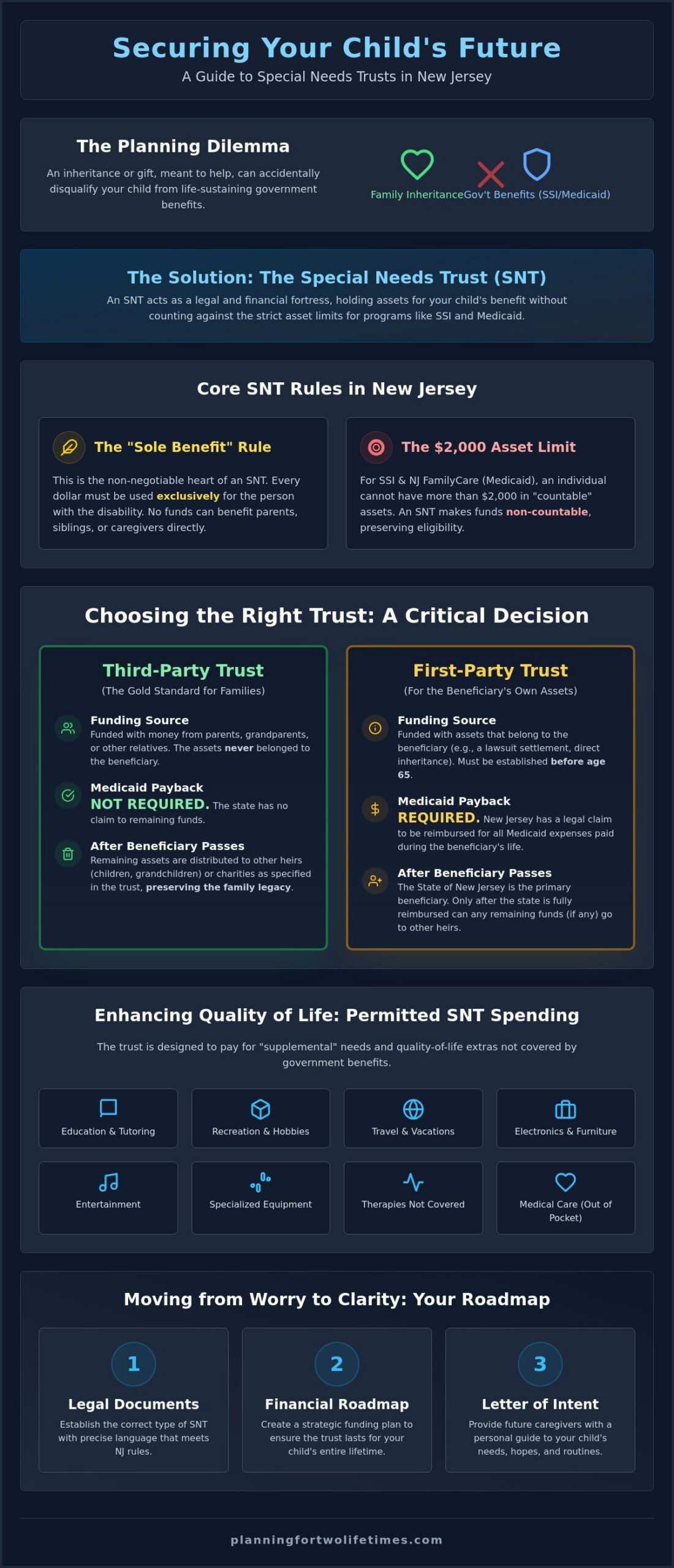
The financial landscape for families in our state is shifting. By 2026, the cost of care and housing in New Jersey has reached new heights, making the margin for error in your estate planning thinner than ever. You aren’t just looking for a document; you’re seeking a fortress. A Special Needs Trust (SNT) acts as that fortress, allowing you to house assets for your child’s future without triggering a loss of the government benefits they rely on for survival. It’s a sophisticated legal and financial tool that demands precision.
The “Sole Benefit” rule is the non-negotiable heart of this strategy. Under special needs trust rules NJ, every cent held within the trust must be used exclusively for the person with the disability. There is no room for ambiguity here. If the New Jersey Department of Human Services or the Division of Medical Assistance and Health Services (DMAHS) suspects that trust funds are benefiting a sibling, a parent, or a caregiver, the shield is pierced. The result? A catastrophic loss of eligibility and potential demands for Medicaid reimbursement. Why take that risk with your child’s stability?
Protecting SSI and Medicaid Eligibility in NJ
In New Jersey, the $2,000 asset limit for Supplemental Security Income (SSI) remains a rigid, unforgiving ceiling. Crossing this threshold by even a single dollar can lead to an immediate suspension of payments. Because NJ FamilyCare (Medicaid) is often tied directly to SSI eligibility, the stakes are doubled. A properly structured trust ensures these funds are classified as “non-countable” assets. These trusts are specifically designed to provide for the “extra” needs that Medicaid does not cover, acting as a bridge between basic survival and a high quality of life. It’s about funding the gap between what the state provides and what your child actually deserves.
The Supplemental Needs Trust vs. Special Needs Trust
Terminology in New Jersey can be confusing. You’ll often hear practitioners use “Supplemental Needs Trust” and “Special Needs Trust” interchangeably, but the “Supplemental” label is vital. It signals to the state that these funds are intended to enhance life, not replace the basic food and shelter covered by government programs. Avoiding generic, “one-size-fits-all” templates is the first step toward true security. New Jersey courts and agencies are increasingly scrutinizing trust language. A document that works in another state might fail here, leaving your child vulnerable. At Pearson Financial Group, we believe in planning for “Two Lifetimes”-ensuring the special needs trust rules NJ requires are met while coordinating your personal wealth with your child’s long-term care needs.
Choosing Between First-Party and Third-Party Trusts in NJ
The decision you make today regarding the source of your trust’s funding will dictate your family’s financial freedom for decades. It’s a choice between retaining your family’s hard-earned legacy or potentially surrendering it to the state. When evaluating special needs trust rules NJ families must first ask: whose money is this? The answer determines whether you are building a Third-Party or a First-Party trust. While both protect benefit eligibility, the long-term outcomes for your other children and heirs couldn’t be more different.
Third-Party Trusts: The Parent’s Legacy Tool
For parents and grandparents, the Third-Party trust is the gold standard. Because the funds never belonged to the beneficiary, New Jersey doesn’t require a Medicaid payback provision. This means that after your child passes, any remaining assets can be distributed to your other children, grandchildren, or charities. It’s a vital part of a Guide to Special Needs Trusts that every NJ family should study. By integrating this into your broader estate plan, you ensure your legacy serves your entire family while providing a safety net for your child with special needs.
First-Party Trusts and the Medicaid Payback Rule
First-party trusts, often called “Self-Settled” trusts, are necessary when your child receives money directly. This might happen through a personal injury settlement, a retroactive Social Security payment, or an inheritance from a well-meaning relative who didn’t understand the special needs trust rules NJ enforces. To stay eligible for benefits, these assets must be placed in a trust established before the beneficiary turns 65. The catch? The state of New Jersey becomes the primary beneficiary upon your child’s death. Every dollar spent by Medicaid on your child’s behalf must be reimbursed from the trust’s remaining balance before a single cent goes to your family.
Many families find themselves needing both. You might use a Third-Party trust for your life insurance and savings, while a First-Party trust handles a specific settlement. Balancing these two vehicles requires a deep understanding of how they interact with your overall wealth. If you’re feeling overwhelmed by these choices, a special needs financial consultation can help you determine the right mix for your unique situation. Don’t leave your legacy to chance when a clear roadmap is available.
NJ Spending Rules: What Can a Special Needs Trust Pay For?
Once the trust is funded, the weight of responsibility shifts to the trustee. Every disbursement is a matter of public record and government scrutiny. The golden rule is absolute: never give cash directly to the beneficiary. Handing your child a twenty-dollar bill or writing them a check for “spending money” is a technical violation that can trigger an immediate reduction or loss of benefits. Under special needs trust rules NJ enforces, the trust must pay third-party vendors directly for goods and services. One wrong check can freeze a lifetime of support.
Large purchases require even more foresight. In New Jersey, if you are managing a first-party trust, the trustee must notify the Division of Medical Assistance and Health Services (DMAHS) 45 days in advance of any expenditure exceeding $5,000. This also applies to a series of payments to the same vendor that will total more than $5,000 in a single year. Whether you’re purchasing a modified vehicle or funding major home renovations, this notice period is non-negotiable. Failing to comply isn’t just a clerical error; it’s a threat to the trust’s compliance status.
The Food and Shelter Trap (ISM Rules)
The Social Security Administration (SSA) views SSI as a fund specifically for food and shelter. If the trust pays for these items, it’s classified as In-Kind Support and Maintenance (ISM), which can slash your child’s monthly check by up to one-third. Paying for a beneficiary’s groceries directly from the trust is a mistake because Social Security views it as unearned income, triggering an immediate reduction in their monthly SSI check. To avoid this, many families use an ABLE account for these specific costs, as ABLE funds can often cover housing and food without the same ISM penalties.
Quality of Life: Beyond the Basics
The true purpose of the trust is to provide the “extras” that make life worth living. While Medicaid covers basic medical needs, it rarely pays for the highest quality of care—such as the non-medical support services described at providentialfijianhomecare.com—or the social engagement your child deserves. Permitted expenses include:
- Specialized dental work or therapies not covered by NJ FamilyCare.
- Educational tuition, tutors, and job coaching.
- Travel expenses, including tickets for a required companion.
- Electronics, furniture, and home maintenance.
- Professional services like special needs wealth management and tax preparation.
The trustee must maintain meticulous records for every dollar spent. New Jersey state audits can happen at any time, and the burden of proof lies with you. Working with a specialized advisor to vet these distributions ensures that every “quality of life” purchase remains within the strict special needs trust rules NJ mandates, providing your child with comfort while keeping their safety net intact.
Strategic Funding: How to Build a Trust That Lasts Two Lifetimes
Many parents assume leaving the family home or a 401(k) to the trust is the best path. This can be a costly mistake. Real estate is illiquid and comes with high carrying costs. Retirement accounts are even more problematic. Federal tax rates for trusts are highly compressed, with the top rate of 37% hitting at just over $16,000 of income. When a large IRA is liquidated into a trust, a massive portion of your child’s inheritance could be lost to taxes in a single year. Protecting against this volatility requires specialized wealth management for special needs trusts to ensure the principal remains intact for decades.
Life Insurance as a Funding Powerhouse
Second-to-die, or survivorship life insurance, is often the most efficient tool for NJ families. These policies only pay out after both parents have passed, which mirrors the time when the trust will need the most liquidity. Because the policy covers two lives, the premiums are typically more affordable than individual coverage. It’s vital that the beneficiary designation is set correctly to flow directly into the Third-Party SNT. This avoids the special needs trust rules NJ applies to first-party assets and ensures the funds are available immediately to provide for your child’s quality of life without a lengthy probate process. Understanding the full scope of special needs life insurance planning is essential to ensuring your policy is structured in a way that protects your child’s benefits rather than inadvertently jeopardizing them.
The ABLE Account Integration
By 2026, the ABLE Act expansion has changed the game for New Jersey families. The age of disability onset eligibility has increased to 46, and the annual contribution limit has risen to $19,000. An ABLE account should act as a companion to your SNT, not a replacement. Use the ABLE account for smaller, daily expenses like groceries or transit to avoid the “Food and Shelter” traps discussed earlier. Keep in mind that if the ABLE balance exceeds $100,000, SSI payments will be suspended. Balancing these two accounts allows you to maximize liquidity while keeping the bulk of your wealth protected within the long-term trust structure. To ensure your assets are coordinated correctly, consider a special needs financial consultation to build a customized roadmap for your family.
Moving from Worry to Clarity: Your NJ Financial Roadmap
A signed trust document is a powerful shield, but it isn’t a strategy. Many families mistake the legal creation of a trust for the completion of their planning. In reality, a document that merely sits in a drawer does nothing to address the daily complexities of your child’s life or the long-term depletion of assets. To truly master the special needs trust rules NJ demands, you must transition from legal compliance to a comprehensive financial roadmap. This is the difference between having a safety net and having a plan that actually works when you aren’t there to catch them.
The urgency of this “Two Lifetimes” approach cannot be overstated. Every year you wait to fund and coordinate your trust is a year of lost growth and potential exposure to shifting state regulations. Choosing the right trustee is perhaps the most sobering part of this journey. While a sibling or close relative brings love and history, they may lack the technical expertise to manage New Jersey’s strict reporting requirements. A professional fiduciary or a specialized wealth manager can provide the oversight needed to ensure the trust remains compliant with the Division of Medical Assistance and Health Services for decades to come.
Creating Your Letter of Intent
If the trust is the “body” of your plan, the Letter of Intent is its soul. This document captures everything a legal trust leaves out: medical histories, favorite social activities, specific daily routines, and even the small preferences that make your child feel safe. It serves as a vital guide for future trustees and caregivers who may not have your decades of intuition. The Letter of Intent is a moral roadmap, not a legal one, but it is often the most important document you will ever write for your child’s future happiness.
The Power of a Specialized Financial Consultation
Generalist financial advisors often lack the specific training required to navigate the nuances of New Jersey’s special needs landscape. They might understand the market, but they don’t understand how a single inheritance can derail decades of state support. At Planning for Two Lifetimes, we specialize in bridging the gap between your legal documents and the real-world funding your child requires. We help you calculate the “funding gap” and ensure your wealth is managed with the sensitivity and technical precision your situation demands. Don’t leave your child’s dignity to chance. Request your Special Needs Financial Consultation today to start building the security your family deserves.
Secure Your Child’s Legacy Today
The weight of these decisions can feel overwhelming. You’ve seen the risks. You know the stakes. Mastering the special needs trust rules NJ enforces is about more than just checking boxes; it’s about building a fortress around your child’s quality of life. A legal document is only the beginning. True security comes from coordinating your private wealth with government benefits and funding the gap that the state simply won’t cover. It is a journey from high-stakes anxiety to a state of structured calm.
Don’t let these technicalities remain a source of fear. You can move forward with the confidence that comes from professional foresight. Specialized expertise in special needs wealth management is the key to protecting your child’s future. To deepen your understanding and start building your custom roadmap, Download the 100-Page Guide: Planning for Two Lifetimes. This definitive resource is your blueprint for navigating the complexities of trust funding while keeping essential benefits intact.
Your child’s future is worth the effort of thorough preparation. With a steady hand and a clear plan, you can ensure they’re cared for exactly the way you’ve always intended. You’ve got this.
Frequently Asked Questions
Can a Special Needs Trust pay for a car in New Jersey?
Yes, a trust can purchase a vehicle to provide transportation for the beneficiary. This is considered a valid “quality of life” expense under current regulations. However, if you are managing a first-party trust, remember the 45 day advance notification rule for expenditures over $5,000. The vehicle should be titled in a way that doesn’t count as a personal asset for the beneficiary, often by having the trust itself hold the title.
How much money can you have in a Special Needs Trust in NJ?
There is no upper limit on the amount of assets a Special Needs Trust can hold in New Jersey. While programs like SSI and Medicaid have strict $2,000 resource limits for the individual, the trust acts as a safe harbor for any amount of wealth. Whether the trust holds $10,000 or $10 million, the assets remain non-countable as long as the trustee follows the special needs trust rules NJ requires for distributions.
Who can serve as a trustee for a Special Needs Trust?
You can appoint a family member, a trusted friend, or a professional fiduciary like a bank or trust company. The role is demanding and requires meticulous record-keeping and a deep understanding of government benefit rules. Many families choose a “co-trustee” arrangement, pairing a family member who knows the beneficiary’s heart with a professional who understands the complex financial reporting and tax obligations.
Can a parent be the trustee of their child’s Special Needs Trust?
Yes, parents frequently serve as the initial trustees of their child’s trust. It’s a natural choice because you understand your child’s needs better than anyone else. You must be extremely careful to avoid “commingling” your personal funds with trust assets. Every penny spent must be documented and paid directly to third-party vendors to avoid triggering a reduction in your child’s monthly SSI payment.
Is a Special Needs Trust the same as a Supplemental Needs Trust?
In New Jersey, these terms are functionally the same, though “Supplemental” is often used to emphasize the trust’s purpose. The goal is to supplement, not replace, the basic food and shelter provided by state programs. Using the term “Supplemental” in the trust’s title or language can help clarify to state agencies that the funds are intended for quality-of-life enhancements rather than basic survival needs.
What happens to the money in a Special Needs Trust when the beneficiary dies?
The outcome depends entirely on the type of trust you’ve created. In a first-party trust funded by the beneficiary’s own money, New Jersey law requires a Medicaid payback to reimburse the state for care costs. In a third-party trust funded by your assets, there is no Medicaid payback. You have the total freedom to name successor beneficiaries, such as siblings or charities, ensuring your family legacy remains protected.
Does a Special Needs Trust protect against Medicaid estate recovery in NJ?
A properly structured third-party trust is a powerful shield against Medicaid estate recovery. Because the assets never legally belonged to the beneficiary, the state cannot seize them after the beneficiary passes away. First-party trusts offer benefit protection during the beneficiary’s life but are subject to recovery at the end. This distinction is why choosing the right trust type is the most critical decision in your financial roadmap.
How do I fund a Special Needs Trust if I don’t have a lot of savings?
You don’t need a massive windfall to start protecting your child’s future. Many families use survivorship life insurance, which provides a significant payout only after both parents have passed. A comprehensive approach to special needs life insurance planning ensures that your policy is correctly structured to flow into the trust without triggering benefit disqualification. You can also coordinate your special needs trust rules NJ strategy with an ABLE account, which allows for smaller, tax-advantaged contributions of up to $19,000 annually in 2026. Consistent, small steps today build the security your child will need tomorrow.