
What if the inheritance you’re building to protect your child is actually the biggest threat to their survival? It’s a sobering thought. For most families, a legacy is a gift, but for a child with a disability, an uncoordinated windfall can trigger a total loss of SSI or Medicaid benefits. This is why a special needs financial consultation isn’t just about picking stocks. It’s about building a fortress around your child’s future. You’ve likely spent countless nights wondering what happens when you’re no longer there to manage the details. With the federal SSI payment at $994 and complex 2026 rules for ABLE accounts now in effect, the stakes for your planning couldn’t be higher.
We understand that “what-if” anxiety. It’s heavy. You want to know that your child will be safe, housed, and cared for across two lifetimes. This article will show you how to move from that high-stakes worry into a state of structured calm. We’ll explore how to coordinate private wealth with public assistance, ensuring your child benefits from both without disqualification. You’ll learn the essentials of trust funding and how a vetted strategy can bridge the gap between your life and theirs. Peace of mind isn’t a luxury. It’s the result of a clear, written roadmap that protects what matters most.
Key Takeaways
- Understand why traditional financial planning often fails special needs families and how to design a roadmap that accounts for two complete lifetimes.
- Learn why a special needs financial consultation serves as a vital audit of your current trajectory rather than a simple product pitch.
- Discover how to synchronize your private wealth with government programs to avoid the $2,000 asset limit trap that often disqualifies beneficiaries for SSI and Medicaid.
- Identify common but devastating mistakes, such as leaving assets directly to a child or naming an unqualified family member as a successor trustee.
- Transition from high-stakes anxiety to a state of structured calm by utilizing a comprehensive, 100-page guide designed for every stage of your journey.
The Two-Lifetime Challenge: Why Special Needs Financial Planning is Different
Most financial planning is built on a single timeline. You work, you save, and you retire. For families with a child with a disability, that timeline is insufficient. Special needs financial planning is a specialized discipline that focuses on the financial longevity of two distinct lifetimes: the caregiver and the beneficiary. It’s a complex dance between providing for your own retirement and ensuring your child is supported long after you’re gone. Standard financial planning often fails these families because it ignores the unique intersection of private wealth and public policy. A traditional advisor might suggest a standard inheritance, but for your child, that “gift” could be a disaster.
Inaction is a choice with high stakes. Without a dedicated special needs financial consultation, families often fall into the trap of accidental disinheritance. This happens when well-meaning parents leave assets directly to a child, unaware that doing so can disqualify them from essential government programs. Precision is required. This consultation bridges the gap between the care you provide today and the security your child needs tomorrow. It transforms a vague sense of worry into a documented, actionable strategy.
The Reality of Accidental Disinheritance
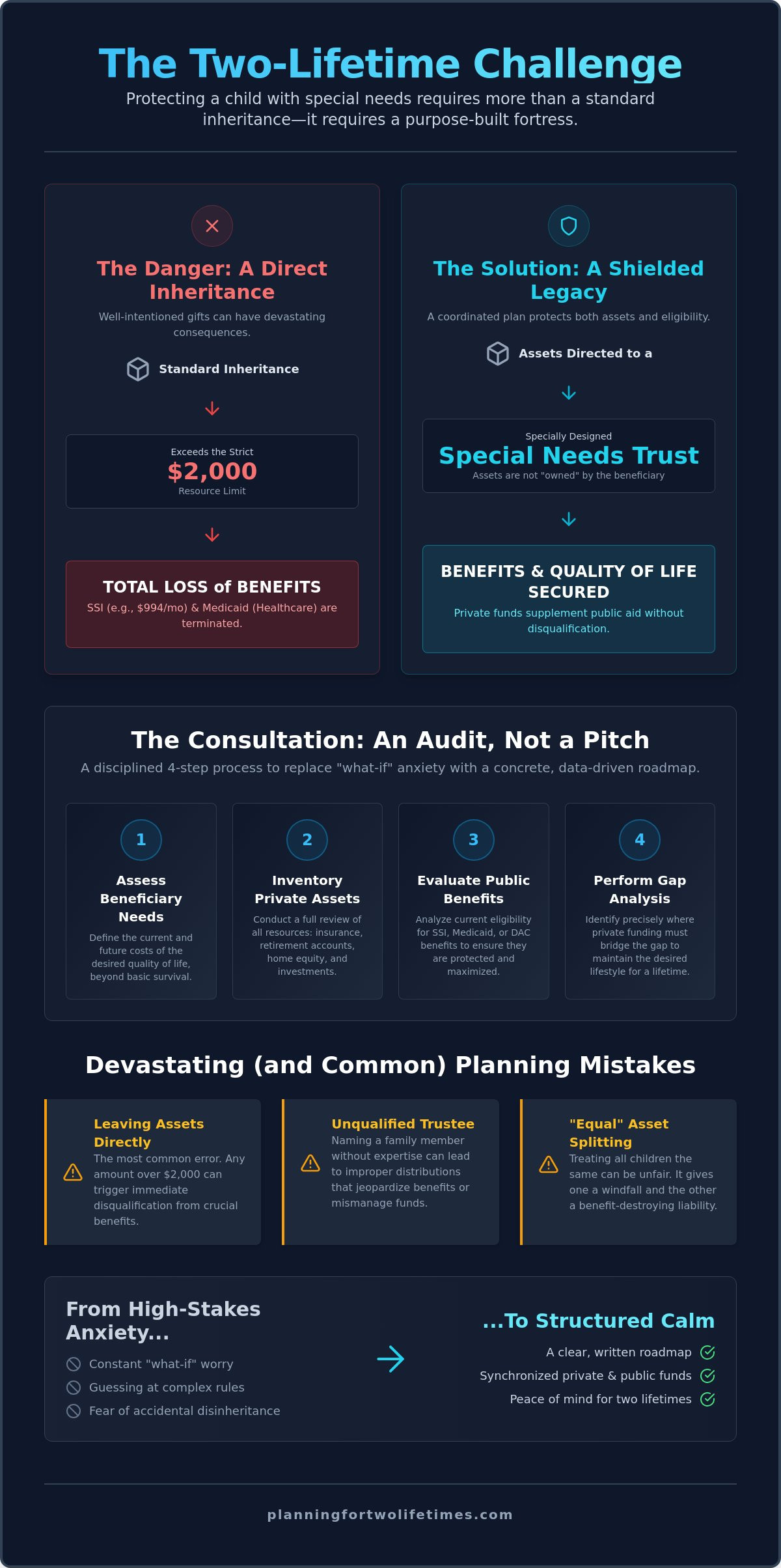
A simple, standard inheritance can trigger a total loss of government benefits. Most federal programs, including SSI and Medicaid, have a strict $2,000 resource limit. If your child receives a direct payout from a life insurance policy or a traditional will, they could lose their healthcare and monthly income overnight. The emotional toll of “guessing” at these requirements is exhausting. Many parents try to be “fair” by splitting assets equally among siblings, but this strategy often backfires. One child receives a windfall they can use, while the other receives a windfall that ruins their legal eligibility for support. Utilizing a Special Needs Trust is often the only way to provide for a child’s quality of life without sacrificing their safety net.
Moving from Anxiety to Structured Calm
You don’t have to be an expert in federal regulations to protect your child. The role of a specialized advisor is to act as a mentor, guiding you through the maze of state and federal rules with a steady hand. There’s profound psychological relief in moving from a state of high-stakes anxiety to one of structured calm. This transition begins when you have a professional roadmap in your hands. Our “Planning for Two Lifetimes” philosophy isn’t just about money; it’s about the continuity of care. We focus on creating a clear path that ensures your child’s future is never left to chance. By coordinating your private assets with government eligibility, you create a fortress of protection that lasts for two lifetimes.
What Happens During a Special Needs Financial Consultation?
A specialized consultation is an audit of your current trajectory, not a product pitch. It is a rigorous, technical examination of the path you are currently traveling. We don’t start with investments. We start with the human being at the center of the plan. A special needs financial consultation is designed to replace your “what-if” anxiety with a series of concrete, data-driven answers. Precision is the only real antidote to the fear of the unknown. We look at your current preparation and determine exactly where it leads, identifying potential pitfalls before they become crises.
The process follows a disciplined four-step sequence. First, we assess the beneficiary’s current and future support needs. This goes beyond basic survival. We look at the cost of the quality of life you want for them. Second, we take a full inventory of your private assets. This includes insurance policies, retirement accounts, and home equity. Third, we evaluate your child’s current government benefit status. Whether they are receiving SSI, Medicaid, or Disabled Adult Child (DAC) benefits, we ensure these are protected. Finally, we perform a gap analysis. We identify exactly where private funding must supplement public aid to maintain your child’s lifestyle for their entire life. Many resources on Special Needs Financial Planning for Families emphasize these core components as the foundation of any secure estate.
The Discovery Phase: Beyond the Numbers
Numbers alone don’t tell the whole story. During the discovery phase, we help you document a “Letter of Intent.” This is essentially the instruction manual for your child’s life. It captures their daily routine, medical history, and quality-of-life goals. We also identify the future “Care Team.” This includes guardians, trustees, and advocates who will step in when you cannot. We evaluate the readiness of your current legal documents. A standard will is rarely enough. We determine if your current structures are built to withstand the scrutiny of government agencies while providing the flexibility your child deserves.
The Strategic Roadmap Delivery
The final result of your consultation is a written, actionable financial roadmap. It isn’t a vague suggestion; it’s a tactical plan. We coordinate closely with your legal team to ensure our financial strategies match the specific language in your trust. This synchronization is what prevents the “accidental disinheritance” mentioned earlier. You will also receive our 100-page “Planning for Two Lifetimes” guide. This serves as your essential reference tool for every stage of the journey. You can begin this process by starting with a specialized roadmap that prioritizes your child’s long-term security. Having a documented plan allows you to finally breathe, knowing the details are handled.
Synchronizing Private Wealth with Government Benefit Eligibility
The absolute priority of any specialized planning is protecting eligibility for Supplemental Security Income (SSI) and Medicaid. For most, this means navigating the treacherous $2,000 resource threshold. One dollar over this limit can collapse a child’s entire support system. It’s a high-stakes balancing act. A special needs financial consultation ensures that your private assets work in harmony with these programs rather than against them. Private wealth management should never replace government aid; it should enhance it. We focus on a synchronization that preserves public dollars while utilizing your private legacy to provide a life worth living—which includes maintaining a healthy home environment; for instance, you can learn more about Pronto Air Duct Cleaning to see how professional services support this quality of life.
The golden rule of this synchronization is “Supplement, Not Supplant.” Trust funds are designed to pay for the things that public benefits do not cover. This includes specialized therapies, travel, electronics, or personal care attendants. Spending trust money on basic food or shelter can sometimes reduce SSI payments, so every disbursement must be strategic. By following established special needs financial planning strategies, you can ensure that your child enjoys a higher quality of life while their basic safety net remains untouched. It’s about moving from a state of constant “what-if” anxiety to a structured, reliable calm.
The Role of the Special Needs Trust (SNT)
Choosing the right trust structure is critical. A Third-Party SNT is funded by you or other relatives and offers the most flexibility. It doesn’t require a Medicaid “payback” provision upon the beneficiary’s death, allowing remaining funds to stay within the family. Conversely, a First-Party SNT is funded with the beneficiary’s own assets, such as a legal settlement. Funding these trusts requires efficiency. Life insurance is often the most effective tool because it provides a guaranteed windfall exactly when it’s needed most. We also tailor investment strategies to the beneficiary’s long-term care horizon, prioritizing stability to cover decades of potential care.
Leveraging ABLE Accounts (529A)
ABLE accounts are a powerful companion to a trust. As of 2026, the annual contribution limit has increased to $20,000, providing significant tax-advantaged savings for individuals whose disability began before age 46. These accounts offer daily spending flexibility that trusts sometimes lack. The interplay is vital. The first $100,000 in an ABLE account is exempt from the SSI resource limit. If the balance exceeds that amount, SSI payments are suspended, though Medicaid eligibility typically continues. By using an ABLE account for frequent expenses and a trust for long-term wealth, you create a dual-layered defense for your child’s financial future.
Common Financial Mistakes a Consultation Can Prevent
Small errors in a legacy plan often lead to catastrophic failures. A special needs financial consultation acts as a rigorous safety net, identifying these technical glitches before they manifest as a crisis. Leaving assets directly to a child is the most frequent error we see in the field. It is a well-meaning gesture that triggers immediate disqualification for SSI and Medicaid. Even a modest savings account in your child’s name can violate the $2,000 resource limit. This isn’t just a minor inconvenience; it’s a total collapse of their safety net. Precision is the only way to avoid this trap.
Many parents also fail to update beneficiary designations on their IRAs and 401(k)s. These accounts operate outside of your will. If you name your child as a direct beneficiary, the assets will bypass your carefully crafted trust and land directly in their name. This “silent killer” of benefits is often discovered only after a parent passes away. Furthermore, we frequently encounter families who have significantly underestimated the 50-year cost of specialized care. You aren’t just planning for a typical retirement. You’re planning for a lifetime of support that may span six decades, requiring a level of funding that standard calculators simply cannot project. Accessing specialized financial guidance for parents of special needs children can help you accurately model these long-term costs and avoid critical funding gaps.
The Fiduciary Trap
Naming a sibling or a close relative as a successor trustee sounds like a compassionate choice. In reality, it often places an unbearable burden on them. Professional asset management for special needs trusts is usually safer than a DIY approach. Family members often face “Trustee Burnout” as they struggle to manage their own lives while navigating the complex distribution rules of a trust. A professional fiduciary ensures that investment strategies align perfectly with the trust’s specific language. This oversight protects the beneficiary from administrative errors and preserves the family relationship by removing the conflict of money.
The Retirement Conflict
You cannot pour from an empty cup. A successful plan must address the parents’ financial health first. We often see parents sacrifice their own retirement security to fund their child’s future, which only creates a different kind of crisis later. We use strategic tools like “survivorship” life insurance to fund the future gap. This allows you to prioritize your own retirement while knowing a guaranteed windfall will be there for your child exactly when it’s needed. You can begin securing both lifetimes by scheduling a special needs financial consultation to audit your current trajectory. Balancing your needs with theirs is not selfish; it is the foundation of a sustainable legacy.
Securing the Future: The Planning for Two Lifetimes Approach
The shift from high-stakes anxiety to a state of structured calm is the ultimate goal of our work. It is the moment you realize that your child’s future is no longer a collection of “what-ifs,” but a documented reality. This transition requires more than just a standard investment account. It demands a philosophy that accounts for the unique longevity of two separate lives. As a specialized division of Pearson Financial Group, we provide the institutional strength of a major firm combined with the compassionate, mentor-like guidance your family deserves. We don’t just manage wealth; we protect legacies.
Our flagship 100-page guide serves as the essential starting point for this journey. Available in both digital and physical formats, this comprehensive tool helps you navigate the complexities of estate planning and benefit protection at every stage. It’s designed to be a living reference, offering clarity when the world of government regulations feels overwhelming. You can request your copy of the guide today to begin building your roadmap. Having this resource at your fingertips provides a sense of immediate security, knowing you have a vetted strategy for trust funding and asset coordination.
Beyond Asset Management
Our commitment to your family extends far beyond simple asset management. We provide a steady hand for the next generation of caregivers, ensuring that the transition of responsibility is seamless and supported. This includes ongoing education and rigorous monitoring of benefit policies. As regulations change, such as the 2026 adjustments to ABLE account eligibility and SSI cost-of-living increases, we ensure your plan remains in total compliance. The “Two Lifetimes” promise means we are planning for your life and theirs simultaneously. We act as a protective shield, navigating the shifting landscape of federal and state laws so you don’t have to.
Your Next Steps to Clarity
Requesting a special needs financial consultation is the first step toward reclaiming your peace of mind. The process is simple and focused entirely on your specific family dynamics. To maximize the value of your first meeting, we recommend bringing current benefit award letters, an inventory of all private assets, and any existing legal documents like wills or trusts. This allows us to perform an immediate audit of your current trajectory. There is a profound urgency in starting this process today. Every day without a plan is a day your child’s future remains vulnerable. By scheduling your special needs financial consultation, you are choosing to move away from confusion and toward a future defined by quiet confidence and long-term security.
Your Child’s Future Deserves a Documented Promise
The security of your child’s future shouldn’t rest on a series of “best guesses.” You’ve seen how a standard inheritance can accidentally trigger a total loss of SSI and Medicaid benefits. You’ve also learned that true protection requires a synchronization of your private legacy with complex government regulations. The stakes are high. The solution is structure. By moving away from high-stakes anxiety and toward a documented roadmap, you ensure that your child is cared for exactly as you intend, long after you are gone.
As a specialized division of Pearson Financial Group, we offer the expertise needed to coordinate your private wealth with public aid eligibility. Our 100-page comprehensive planning book is more than a guide; it is a tactical manual for your family’s security. Don’t wait for a crisis to discover the gaps in your current plan. Starting a special needs financial consultation today is the most protective act a parent can take.
Request Your 100-Page Guide and Schedule Your Consultation Today. You have spent a lifetime protecting your child. Let us help you ensure that protection never ends.
Frequently Asked Questions
What is a special needs financial consultation?
A special needs financial consultation is a specialized audit of your family’s current financial trajectory, specifically designed to protect government benefit eligibility while funding long-term care. It goes beyond standard retirement planning by addressing the unique intersection of disability law, tax strategy, and asset management. By analyzing your current preparation, an advisor identifies technical pitfalls that could lead to benefit disqualification. This process provides a clear, written roadmap for two lifetimes of security.
Do I need a special needs financial advisor if I already have a lawyer?
Yes, because legal documents are only as effective as the financial strategy used to fund them. While a lawyer drafts the specialized language for your trust, a financial advisor ensures your assets, insurance, and retirement accounts are correctly coordinated with those documents. This partnership prevents the common error of “accidental disinheritance” where assets bypass the trust. You need both a legal architect and a financial builder to ensure your child’s future is truly secure.
How much does a special needs financial consultation cost?
The cost for a professional consultation depends on the complexity of your family’s situation and the depth of the planning required. Every family has different needs, ranging from basic benefit protection to complex wealth management for multi-generational trusts. Rather than viewing this as a standard expense, it’s helpful to consider it an investment in preventing costly mistakes. These errors could lead to the loss of thousands of dollars in monthly government support and healthcare coverage.
Will a special needs trust affect my child’s SSI benefits?
A properly structured and managed Special Needs Trust will not disqualify your child from SSI or Medicaid. Because the assets in the trust aren’t legally owned by the beneficiary, they don’t count toward the strict $2,000 resource limit. This allows your child to maintain their safety net while using trust funds for quality-of-life expenses. It is the most effective way to provide a legacy without jeopardizing essential state and federal aid.
Can a financial advisor help me set up an ABLE account?
A financial advisor helps you leverage an ABLE account as a tactical tool within your broader special needs financial consultation strategy. While you open the account through a state portal, an advisor provides the guidance on how to fund it and when to use it for daily expenses. They help you monitor the $100,000 SSI suspension threshold and ensure contributions stay within the $20,000 annual limit established for 2026.
What is the ‘Two-Lifetime’ planning approach?
The “Two-Lifetime” approach is a specialized philosophy that synchronizes the caregiver’s retirement needs with the beneficiary’s lifelong care requirements simultaneously. Traditional planning often focuses only on the parent’s retirement date. This approach looks much further, bridging the gap between the parent’s longevity and the child’s future needs. It ensures that when you are no longer here, the funding and care team are already in place to maintain your child’s quality of life.
When is the best time to start special needs financial planning?
The best time to start is immediately, regardless of your child’s age or your current net worth. Early planning allows you to use time to your advantage, especially when funding long-term care through tools like life insurance. Waiting until a crisis occurs often limits your options and increases the risk of benefit loss. Starting today replaces high-stakes anxiety with a sense of structured, long-term calm and professional foresight.
Can a special needs trust pay for things like travel or a car?
Yes, a Special Needs Trust is specifically designed to pay for supplemental expenses like travel, electronics, or a modified vehicle. The “Supplement, Not Supplant” rule allows trust funds to cover items and services that Medicaid and SSI don’t provide. This enhances your child’s quality of life. However, payments must be made directly to the service providers rather than given as cash to the beneficiary to avoid a reduction in their monthly SSI payment.